Jon Lee Anderson
Journalist
What are we willing to die for
By Jon Lee Anderson
I grew up with an exalted notion of the way men should be. It involved concepts of honour, valour, chivalry. Men of previous generations had been reared on such myths of manhood, and I understood that the process for their attainment included rituals of sacrifice, the confronting and overcoming of fear. The ultimate condition of manhood was bravery.
In the history and the literature that I found most stimulating, I found people who were brave to be admirable. I admired people who risked their lives.
When I was three, my father and I watched from a hill overlooking Seoul as a mob of students assaulted the palace of the Korean dictator Syngman Rhee and were machine-gunned by guards. Nearly two hundred died. I have no memory of it, but it lives somewhere in me.
A few years later, we were living in Taiwan. American soldiers fighting in Vietnam were brought there twice a year on three-day breaks known as R & R. My mother once befriended two of the soldiers, Bud and Rich, and invited them to stay with us for a weekend. I was nine or ten and fascinated by them. They had just come out of the jungle and were going back. They told me about killing. I asked one of them to bring me back a Viet Cong beret.
It wasn’t quite real to me.
Six months later, only Bud came back. Rich had died in his arms.
In such ways, I didn’t have the luxury of assuming that war was something that had only occurred in the past, something alien to me or my family. It was everywhere, it seemed, all around me, and I felt that I had to know it firsthand.
As a kid I made lists of things I wanted to do to complete my personal education: climb Everest, cross the Sahara on foot, row a boat across the Atlantic, go to prison, become a Welsh coal miner.
Go to war.
These were the ways I intended to confront danger, overcome fear and become brave.
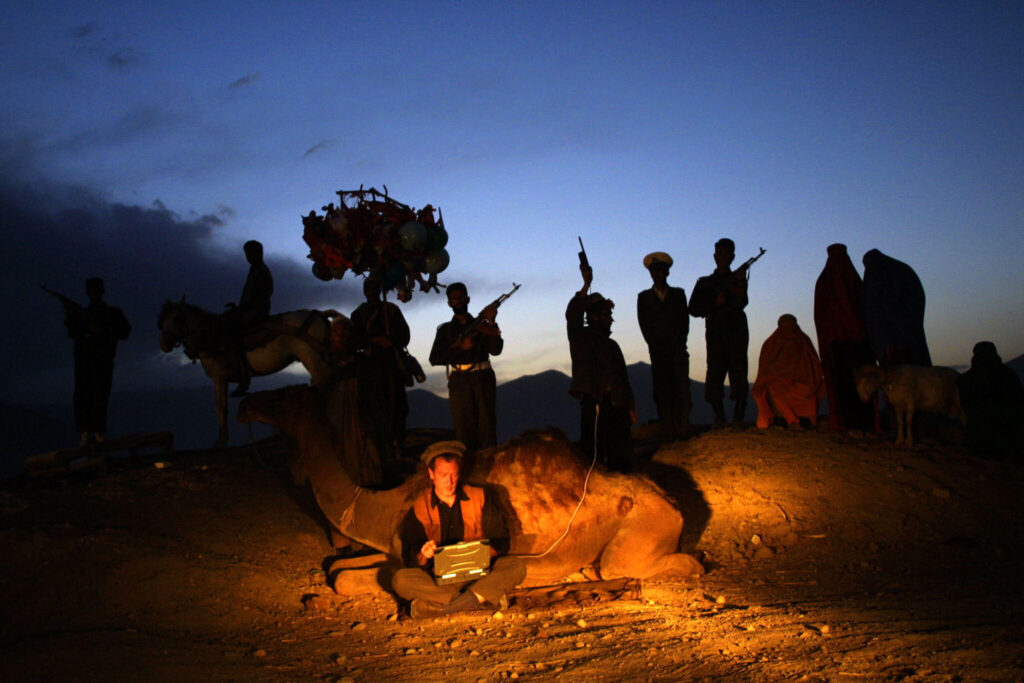
The first time I experienced war was in Guatemala in 1982. I was twenty-five and had gone there as a reporter in order to chronicle the civil war, which had been going on for years but lately, after a military coup, had a bloody upsurge. Death was all around. I found wrecked villages empty of people, kid’s toys and women’s bloodstained clothing left strewn behind. Armed men wearing face masks stopped vehicles on the roads. One day I saw two men who had been captured by soldiers being led away at gunpoint, with nooses around their necks, to an unknown destination. It seemed clear they were about to be executed. You could see the fear, and the resignation, on their faces, and the soldiers, sniggering, drew their fingers across their throats when I asked what they were going to do with them.
A few years earlier, as a teenager, I’d wanted to join Nicaragua’s Sandinista revolutionaries as a fighter myself. I was both seduced by the romantic ideal of insurrection, and by the idea of fighting against a dictator. It would be a noble action, perhaps even a heroic one. I didn’t make it there in time. When I finally got to Nicaragua, I went as a reporter, not a fighter—and was travelling with the counter-revolutionaries.
One of the things reporting teaches you is that, from a distance, conflicts are easily idealized. Up close, people begin to look remarkably alike, especially the younger fighters. They are often kids who found themselves on the wrong end of a bullet—or their parents did—and went into the bush because it became the only way they knew how to survive. Others, much like the younger me, took up weapons because of ideas about manhood, and of good versus evil.
Another thing you learn is that rebels who start out fighting for what they believe to be a good cause sometimes turn into violent oppressors themselves.
For a long time, when we thought about uprisings we thought of guerrilla fighters, liberation movements, armed revolution, and charismatic leaders. The aftermath of the Second World War created an extraordinary faith that the world could be remade through armed action, fueled by idealism. Che and Fidel embodied that faith, and for the next half century, across Africa, Latin America and Asia, countless young people tried to emulate them in the belief that they, too, could overthrow one order and construct a new, better one.
Today, in a time of tumult and disorder, impressive new technology has given young people the feeling that they, too, can change the world.
The first time I became aware that a modern technology was instrumental to an uprising was in 1989, when the student protestors who had occupied Tiananmen Square – before the terrible crackdown – used fax machines to communicate with the outside world. Then came the Internet, and email, mobile phones and social media. Suddenly you no longer had to meet three other people in a garage somewhere and whisper to one another.
Technology transformed the capacity to organize and to disseminate ideas. Eventually, it created images capable of triggering events themselves.
In 2011, I joined young Libyan rebels who had taken up arms against Qaddafi in the eastern desert, and when I asked why they had risen up, they talked about what they had seen online. They had been raised in an abstinent, austere culture, but had seen videos of Qaddafi’s children living jet-set lives abroad, drinking Cristal champagne, driving Ferraris, and running around Monaco with Beyoncé.
It pissed them off.
I remember thinking: it can’t be just that. Surely there was some higher, nobler purpose to their rebellion.
But perhaps that is how a trigger works. Something endured for years suddenly acquires an image that makes it real. The image travels. Private resentment becomes shared anger. Something galvanizes. Fear falls away and is replaced by anger.
Social media gave a new generation an extraordinary instrument. It also created an illusion: that possessing the instruments of mobilization meant possessing power. The Arab Spring showed how fragile that assumption could be. Revolutions were stolen, crushed or transformed into bloody hydra-headed wars. The same technologies that allowed young people to organize allowed the regimes they rose up against to identify them, and, more often than not, to outsmart them, and ultimately to crush them.
Because Power learns too.
And there is another paradox that I find harder to understand.
In Western societies, young people sometimes seem remarkably reluctant to take the kinds of physical and political risks taken by previous generations. There are obvious exceptions. Occupy Wall Street. The Gaza protests. Above all, Black Lives Matter. After George Floyd was killed in Minneapolis, social media allowed millions of people to watch a man being asphyxiated by a policeman almost in real time. The image produced an almost old-fashioned response: people left their screens and went into the streets.
But these eruptions have often been intense and brief.
Perhaps this isn’t a matter of apathy, or of faddishness. Perhaps young people in wealthy societies simply have more to lose—or more ways to retreat from political life, from reality, into screens. We now carry entire alternative worlds in our pockets. We can work, communicate, consume, be entertained and express political outrage without ever physically entering a public square. Technology is simultaneously an extraordinary instrument of mobilization and an extraordinary instrument of withdrawal and status quo.
And perhaps something else has changed too: our relationship to violence, particularly our ideas about masculinity.
Men of previous generations were raised, for better or worse, with the notion that confronting physical danger was part of becoming a man. Western societies have spent decades dismantling that code, along with militarism and the idea that meting out violence in defense of something good can be a legitimate expression of courage.
Did something about the nature of revolt change with it?
Maybe bravery now expresses itself differently.
Maybe the young activist who rejects the heroic gesture, who organizes through networks, who works patiently inside institutions, who thinks in terms of abstract timelines rather than in the single spectacular moment of insurrection, is not less courageous at all. Perhaps this generation is playing a longer game.
But can they take power? Can they sustain themselves? Can they transform the structures they rise against? Can long-term activism achieve what the old revolutionaries believed could be achieved through sacrifice, confrontation and sometimes violence?
I don’t know.
Perhaps that is the question these uprisings are still trying to answer.