
The Earthly Kingdom
by Marija Nikolić, photos by Nemanja Podraščić
I was about the age of my daughter, almost nine, when I first heard my parents and their friends talking about something they called a “protest”. It was early 1991, and I quickly started building my vocabulary: repression, dictatorship, democracy. Over the next few years, I added war, agony, refugees.
Ethnic cleansing was the concept I struggled with most.
I was twelve when I encountered it from a relative distance, learning that some of the friends with whom I used to spend summer vacations had become victims of it. You see, I learned the word genocide before I ever learned about the Holocaust.
At seventeen, I wrote my first political essay, on the sheer absurdity of Milošević’s “defense strategy” against the NATO bombing. That same year, 1999, I joined the Resistance movement, Otpor!, and helped organize protests against his dictatorship in my high school.
Otpor! was not the first and, unfortunately, not the last movement against authoritarian leaders in Serbia. To understand why, one has to go back much further than my own lifetime and decode a couple of persistent symbols.
Some symbols recur in almost every Serbian protest: the fist, the whistle, now a red hand. Others are much older.
Two in particular seem to have survived every Serbian uprising through the ages: Vidovdan and Saint Sava.
Vidovdan marks the Battle of Kosovo, fought on June 28, 1389, when Serbian Prince Lazar died facing the Ottomans. The battle came to symbolize the end of an independent Serbia and the beginning of centuries of Ottoman rule. It is both a national and religious holiday in Serbia.
A legend grew around it: Lazar was offered a choice: win the battle now on earth, or lose now and gain a kingdom later in heaven.
He chose heaven.
That is the myth at the heart of Vidovdan: defeat turned into promise, suffering now in exchange for glory later.
Saint Sava is the other enduring symbol. A thirteenth-century prince who became a monk, he founded the independent Serbian Orthodox Church and helped tie religion, state and national identity together.
Centuries later, that legacy was turned into svetosavlje: the idea that church, nation, state, school and army form one body. Saint Sava became more than a religious figure; he became a political symbol of Serbian unity.
Once you know those two things, the pattern gets embarrassingly obvious.
For centuries, these two symbols served as languages of resistance to Ottoman rule. The myth of Prince Lazar’s sacrifice inspired the First Serbian Uprising against the Ottomans in 1804, which eventually led to the liberation of Serbia.
During World War II, in a country called Yugoslavia, the royalist Chetniks again claimed Saint Sava and the alliance of church and nation, while Tito’s communist Partisans built their legitimacy around a secular, multi-ethnic idea of “brotherhood and unity”. They had no use for saints or curses.
By the time I was a kid learning the word “post-socialism”, svetosavlje had been recycled once again, this time in the service of a much darker, narrower, bloodier idea: deciding who belonged inside that Serbian heavenly kingdom and, more importantly, who did not.
Milošević rode the symbolism of Vidovdan to power in 1989, speaking at Gazimestan, the site of the Battle of Kosovo, and telling the crowd that the battles were not yet over.
Twelve years later, his transfer to The Hague was authorised on the very day of Vidovdan. Legend has it that he asked a guard if he knew what day it was. I have no idea if that is true, but either way, even his downfall ended up being narrated through the same myth.
The new government led by Zoran Đinđić perhaps signaled that Serbia should finally choose the earthly kingdom over the mythical one: pragmatic European democracy over another populist defeat. That idea did not survive much longer than Đinđić himself, assassinated in 2003.
By the time Aleksandar Vučić became Prime Minister in 2014, the game had changed again. Tech-savvy and well connected, he is careful to preserve the stage set of democracy: elections, courts, media…all still standing, all tightly controlled.
Ideology, for him, is less a conviction than a supply closet: svetosavlje for the Church, Europe when he needs Brussels’ money, Moscow to rally the anti-globalists, Israel for spyware against journalists.
Ordinary people get nothing out of it and pay a high price: low wages, failing schools and hospitals, and a grocery bill that keeps growing.
The problem, when people feel abandoned, is that they start looking for something to hold onto. A promise. That is often where the idea of revolt begins to take root.
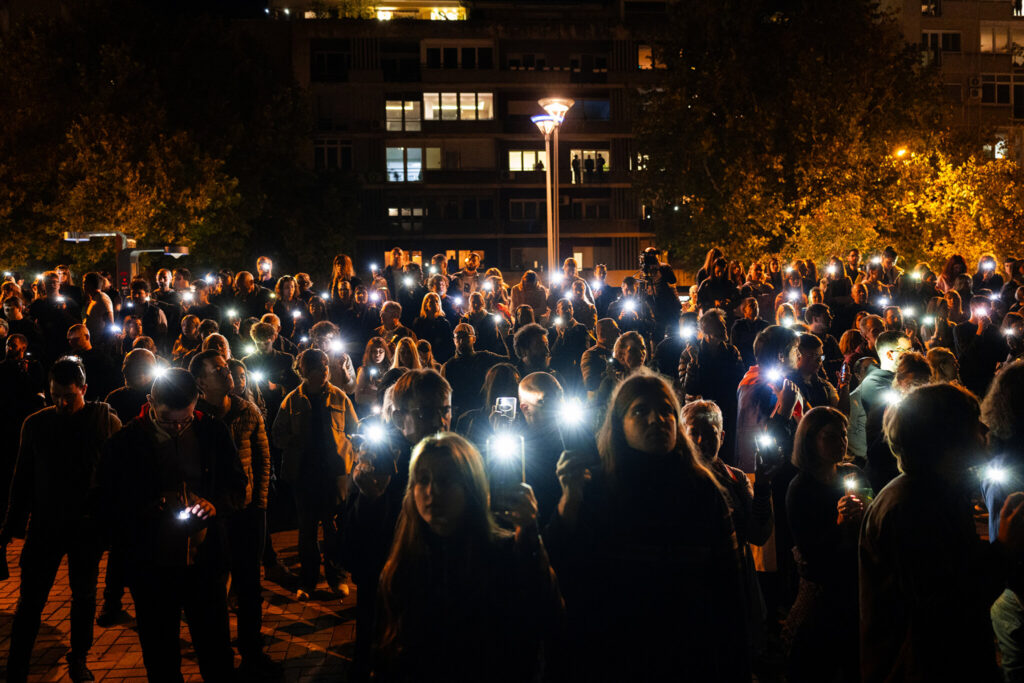
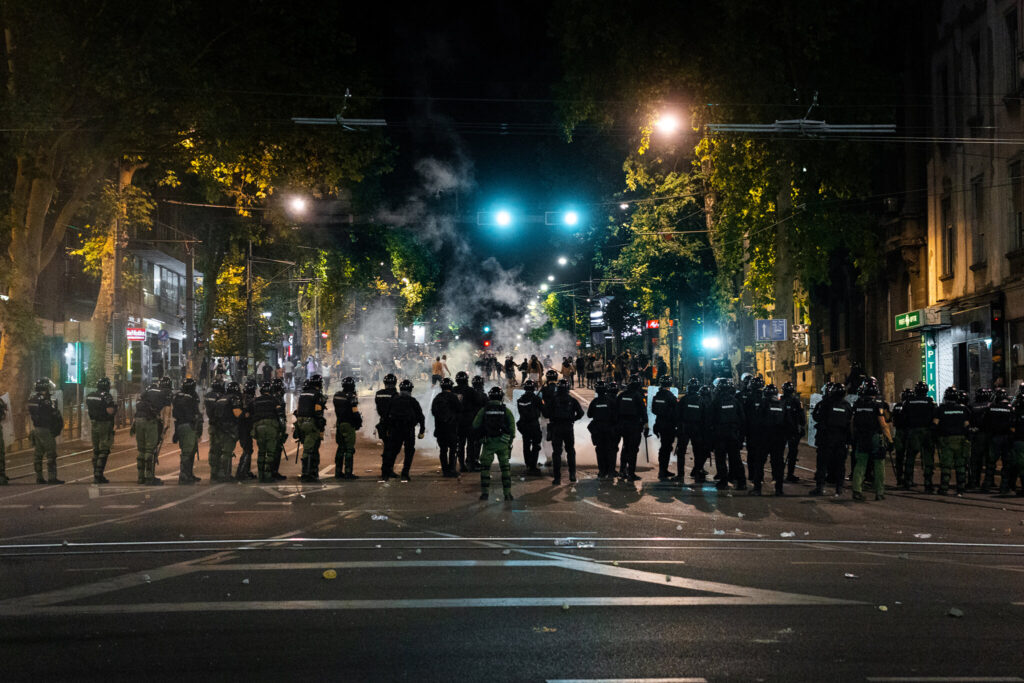
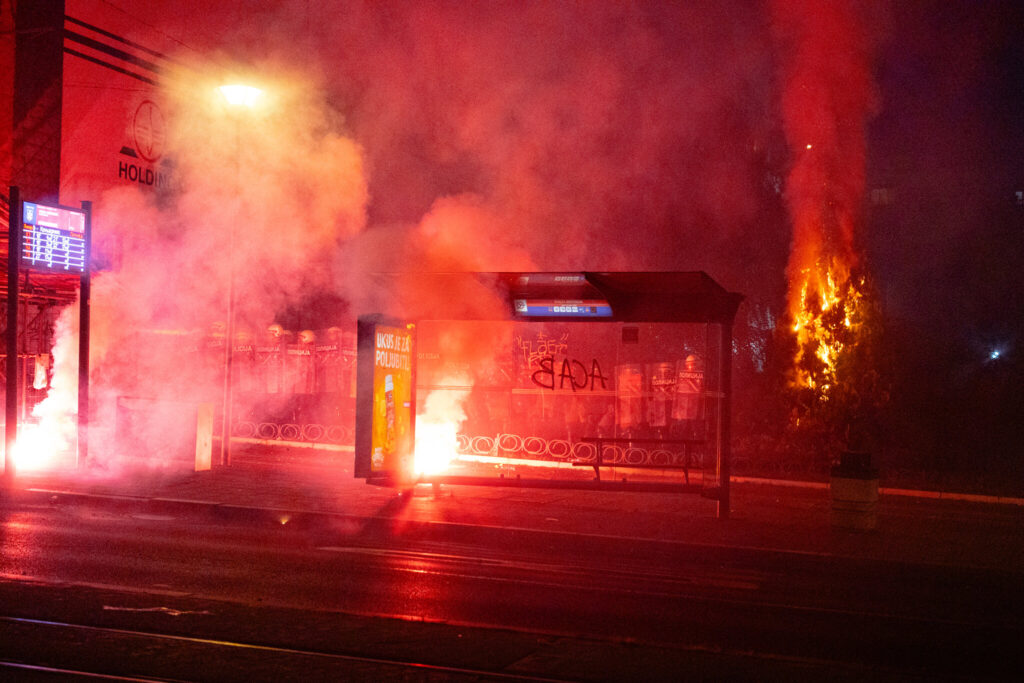
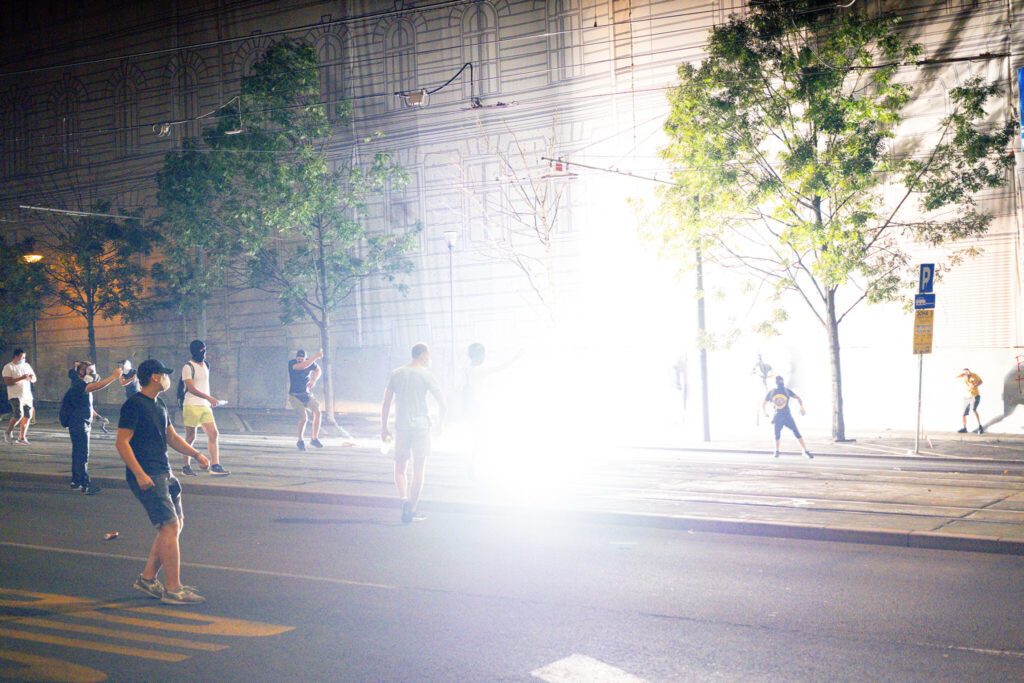
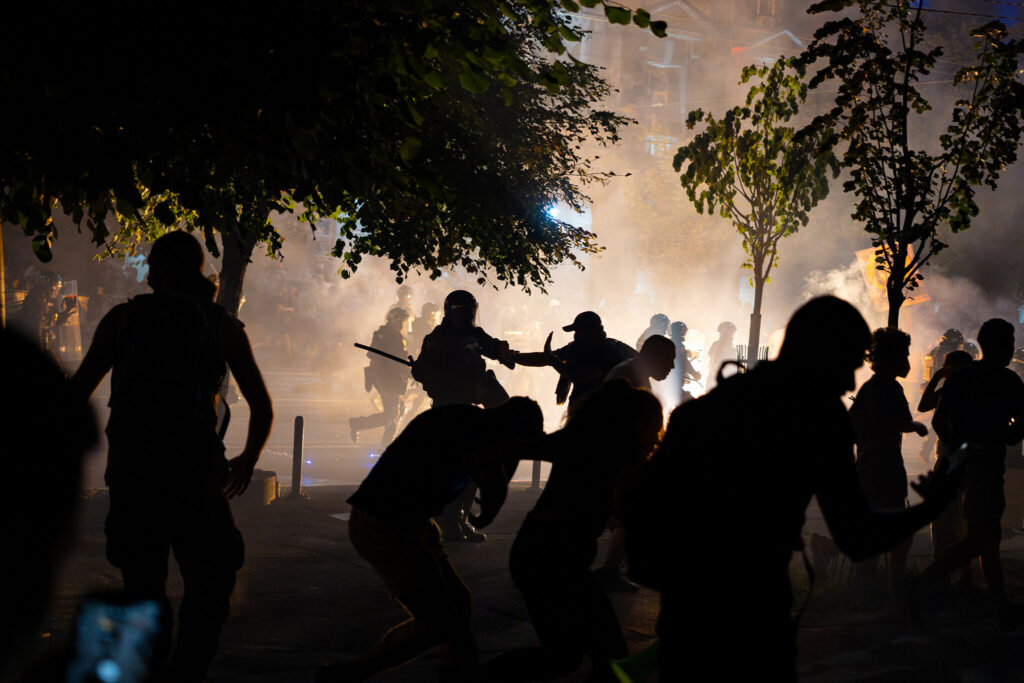
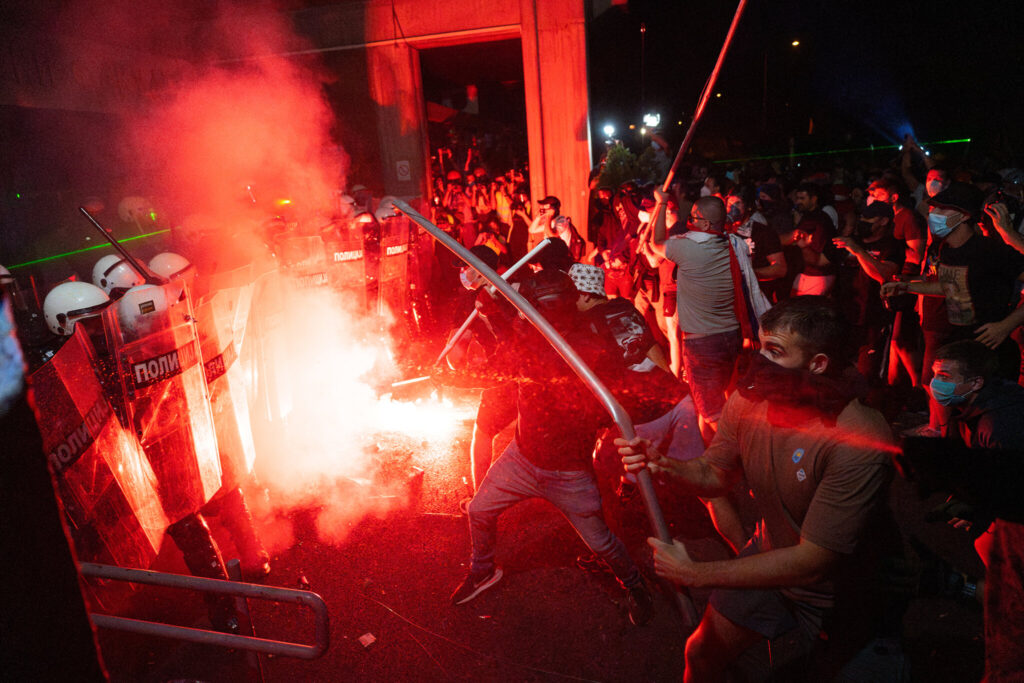
The current student-led anti-corruption uprising began after the canopy of Novi Sad railway station collapsed on November 1, 2024, killing sixteen people.
More than an accident, the disaster quickly came to stand for something much bigger: corruption, negligence and a state failing its citizens. It triggered a broader social movement, drawing people from across the political spectrum, united by anger at government arrogance.
Its prevailing symbol is an open red hand: blood on the system’s hands.
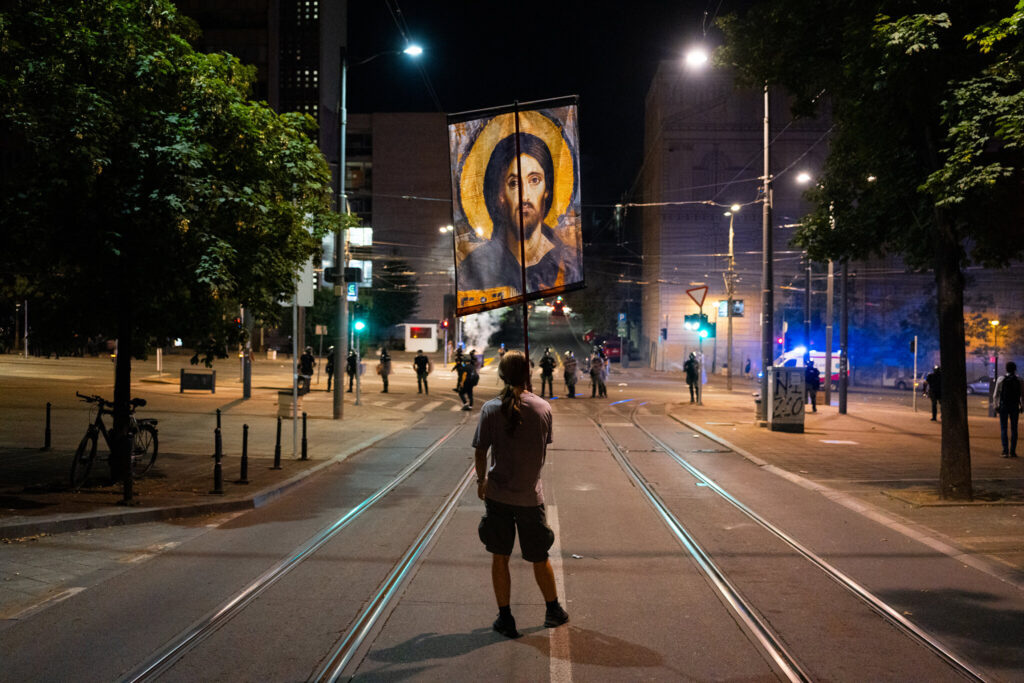
At rallies, you see flags and banners from both the left and the right, university crests and -very visibly- the icon of Saint Sava.
The students insist they want nothing to do with nationalism. They describe the Serbian flags they carry as expressions of patriotism and have joined forces with students from Muslim regions.
Yet one of their biggest rallies in 2025 fell on Vidovdan.
Then, on January 27, 2026, Saint Sava’s holiday, students walked to the Church of Saint Sava in Belgrade under the banner: “The power is in knowledge, not in malice.”
Their Saint Sava is about education, truth, freedom and ethics — an attempt to reclaim the saint and pull him away from the nationalist svetosavlje narrative of one state, one church, one nation.
I like to think the confirmation lies in what happened when the crowd reached the church: they found the doors locked, as if the clergy did not approve of the symbol being reshaped without their permission.
Watching my daughter now, almost the same age I was in 1991, I keep wondering what words she will have to learn.
Maybe she gets to lift Sava’s hood, to see who has been hiding underneath it all along. To understand who used these symbols and why.
Maybe she gets to reverse Lazar’s choice and choose the earthly kingdom this time.
Only then might these symbols finally become a force for healing.